
Posts by Joan Price
Doug, 80: “8 penises on his hands”
Doug, a reader from the Philippines, wrote a comment that was so interesting and helpful that I’m excerpting it here so you won’t miss what he said. Doug wrote,
I am 80 years young and have had ED (erectile dysfunction) all of my life. It has taken me a whole lifetime to come to the point of seeing sex but the tip of the relational iceberg.
Yes, I also know that we men are our penises and our penises are the man. This is a mental hang-up that we need to change.
Doug addresses a reader in an earlier post who wrote that her husband can no longer have erections and has given up on sex and communication. Doug says to this reader,
Until your husband can change the way that he sees his masculinity, he’ll never really feel good about himself. He has eight penises on his hands and the best penis in his mouth. And that up close and personal penis can and does give my wife wonderful, body-shaking orgasms, one right after the other, that most penile intercourse cannot come close.
And best of all, my ego isn’t lying on the ground of mental failure. It works for me and it can work for your hubby.
Doug, you’ve been most helpful to our readers here, and I thank you for sharing your perspective. Would you please contact me personally so I can invite you to be in my next book?
Man writes, “Did I get dumped–or what?” She’s recently widowed.
A male reader, I’ll call him Mark, writes that he recently reconnected with his high school sweetheart from 35 years ago, whose husband had died less than a year ago. Mark and his former sweetheart met again, enjoyed each other’s company (no sex), then later spent a week together and made love joyfully.
Their last day together, she became distant and uncommunicative, and when he returned home, she retreated from the usual phone and email messages they had exchanged regularly before that. She emailed him only once, saying she was having a hard time and was depressed with grief for her husband. She felt strong chemistry with Mark, but wasn’t ready for the kind of relationship that Mark seemed to want. She needs to deal with her issues and doesn’t want to talk to him right now. She hopes he’ll understand.
Mark loves her and is confused. “Did I get dumped — or what?” he asked me.
I don’t know either of them, but I have strong feelings that I do know what’s going on with her because I know the emotional turmoil of grieving and yet wanting to grab onto life. Let me share my experience, hoping that it will help Mark and others in this situation:
For the first six months or so after Robert died, I couldn’t imagine ever wanting a relationship again. After all, I had been honored with seven years of the most profound love with my soul mate — no new man could compare, and why would I want second best after experiencing “best”?
Then the life within me started stirring, then surging. How strange and wonderful that the life force is as strong as it is! I started to feel my sensuality gently knocking on my emotional door, asking to be let in (or maybe let out). I was bewildered and excited by my attraction to a casual friend who was becoming a close confidant.
Fortunately this friend is as committed to honest communication as I am, and was open about discussing my feelings and his own. We both understood that I was heavily into my grieving process still, and it wasn’t the right time to make any decisions or take any actions that I might regret later.
We’re all different in the “right” way to grieve. Not taking our relationship to the next level was the right path for me, and I am grateful to my friend for understanding (even better than I did) that pushing our friendship into something more had potential to hurt, even destroy, the friendship.
I probably would have reacted the way Mark’s lover did — throwing herself into sex and joy and the feelings of coming back to life after an emotional death, but then realizing she was not done grieving and in fact was now having a harder time because she had let herself get involved with someone else too soon.
Mark tells me, “I don’t want to lose this special person in my life.”
So here’s my advice to Mark:
Let her know that you do understand, and that grief is a powerful process with its own timeline that can’t be shortened. Tell her that you want to be in her life in whatever way is possible for her right now, and if that means going back to being non-sexual friends, of course you’ll do that. You do need to understand what she needs and wants from you, even if that changes hourly (grief mood swings are powerful and unpredictable). If she regrets getting sexual with you, could she please tell you so you understand better?
And then let her be. If it’s right, she’ll be back when she’s ready. If it’s not, I hope she can tell you so you can move on.
I hope this is helpful, Mark. Thank you for sharing it with me and with my readers here.
Open Letter to My Line Dancers
Dear Line Dancers,
Thank you for sharing Friday’s class with me. I wanted it to be special as we neared the one-year anniversary of Robert’s death, so I announced that we would devote the whole evening to the contemporary line dances that Robert choreographed for us.
Instead of reteaching the familiar ones that we dance frequently, I brought back some older dances: Night Traveler from early 2001 — the first line dance we choreographed together, before we became a couple. Oh, how I already fantasized sharing more than dance steps with this vibrant, dancing man who brought grace, skill, and enticing hip rolls to our class.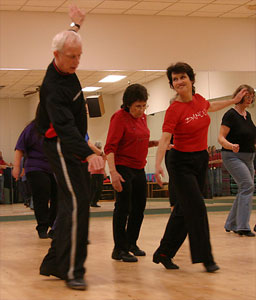
I also taught the lovely Baby Grand, I imagined Robert teaching this slow, graceful, jazz-style dance to the class in 2005, before we knew how few years he had left. As I looked around, I saw other dancers wiping their eyes and I knew we were all dancing with Robert.
When we closed with Music to My Heart, his most popular choreography among our dancers, I couldn’t hold back the tears. Several dancers hugged me, others looked about to fall apart themselves. In the room were people who had never experienced dancing with Robert because they had joined the class after Robert had left it, but they, too, seemed moved and grateful to know him better through his choreography.
After class, I started bawling in the locker room, and cried all the way home. Then later that evening, I realized something: The one-year anniversary of Robert’s death is also the 8-year anniversary of our first kiss. Now that is a day to celebrate, not mourn! I felt that the intensity of the line dance class had helped me purge the grief and invite the light of the love we started sharing with that first kiss on August 2, 2001.
You can see videos of some of Robert’s dances from my line dance page. Many, however, were before the days of ubiquitous digital videocameras and YouTube. I’ll update this post if we record some of these older dances — we do have a plan in the works.
This excerpt from Mary Oliver’s poem, “In Blackwater Woods,” resonates with me today:
To live in this world
you must be able
to do three things:
to love what is mortal:
to hold itagainst your bones knowing
your own life depends on it;
and, when the time comes to let it go,
to let it go.

Ask Me about My Divorce: interview with Candace Walsh
 I started reading Ask Me About My Divorce: Women Open Up About Moving On, a bit worried that it would address concerns and experiences of young women exclusively and not be relevant to us. I’m delighted to be wrong. Although the editor, Candace Walsh, is a young mother, she has an old soul (that’s a compliment) and a mature perspective. The essays she chose for this anthology are filled with wisdom, good writing, and stories that make us nod, remember, often laugh, and sometimes cringe.
The women in these 29 moving essays went through divorces that were sometimes devastating or brutal, but in hindsight, usually inevitable. In some, the women initiated the divorce; in others, they were blindsided by it. Yet all the writers found themselves on a path to self-discovery that was far more enriching and joyful than their marriages had been.
Because I knew I would review the book on this blog, I looked for evidence that some of the writers were over 50. Aha, here’s a clue: this one wore combat boots underneath her wedding dress, six months pregnant with “The Hippie’s” child, and red pumps to her divorce. Ah, this one’s certain: she celebrated her 60th birthday by getting a tattoo….
As I read, I was swept away into the worlds of these courageous women who reinvented themselves after their divorces, and I discovered that it didn’t matter whether they were our age or not. Many of us remember our own divorces with the revelation that we would not have become the people we are if we had not followed that path, willingly or not.
I asked editor Candace Walsh about her insights:
JP: Did you choose these authors and essays because they were able to move on in a rewarding way?
CW: I looked for stories that relayed a “thriving after divorce” experience. I did choose these essays because the women were able to powerfully relate how they had utilized this moment of divorce as a portal to a better life.
JP: Do you think most divorces do — or can — turn out to be a good thing?
CW: My dad told me, “The year your mother and I split up was the worst year of my life. But since then, I’ve had the best years of my life.” There are indeed second acts in American lives. Let’s face it. If you partner leaves you, you have a much better chance of a better life after divorce because otherwise, you’d be with someone who’d really rather not be with you.
JP: About what percentage of these authors are over 50 compared to the younger writers in your anthology?
CW: About 15%.
JP: Does the perspective of age color how your older authors now see their divorces and their lives since then?
CW: It seems to me that they have more of a sense of wanting to seize the day. They also look back and are more forgiving; they feel compassion for their younger selves and their exes. “I don’t know then what I did now, but how could I have?” They appreciate how much more opportunities divorced women and women in general have now than they used to.
JP: What would you say to women over 50 who are in unsatisfying marriages now, but are frightened that being on their own might be worse?
CW: I would say, “Listen to your gut.” It would be easy for me to say, “Take the plunge!” But every situation is different. If both parties are willing to work to improve the relationship and make the other person feel special, treasured and loved, there’s a good chance that it could become something worth preserving. If you feel like you’ve come to the end of the road, or if you and your partner are unwilling to put any reviving energy into the relationship, or if you’re dealing with someone who’s verbally or physically abusive, you may as well get off that bus and begin anew. Today is the first day of the rest of your life.
If you’re over fifty, you have a good 30+ years ahead of you, God willing, and why not enjoy those years? They don’t consist of an epilogue. No way. I am so excited to experience the decades ahead because it seems like a shroud has been lifted and women’s ability to live active, vibrant, sensual, successful lives has been dramatically expanded.
JP: Are your readers exclusively women who are divorced or contemplating divorce?
CW: One young unmarried woman said that it should be required reading for all women before they get married. We need to have a better grounding in the realities of marriage before we sign on. It’s too easy to be seduced by the expectation of a fairy tale. As little girls, we thought we were learning about love by watching princess movies.
What if we’d been coached in relationship skills instead? How to listen, how to take responsibility for our own needs, how to feel anger without lashing out, how to esteem and honor the other as we do the same for ourselves, how to talk about the elephant in the room, how to diplomatically bring up issues before simmering resentments harden into calcified, love-damaging deposits, how to be conscious of what triggers us and take the time to dismantle old hurts so that they don’t dictate our futures. And how to learn from our mistakes so that we don’t repeat them the next time.
Sure, it wouldn’t be as transporting as watching Cinderella whisked away to “happily ever after.” But it might just make happily ever after less of a fairy tale.
Candace Walsh is the editor of Ask Me About My Divorce: Women Open Up About Moving On. She’s also the features editor at Mothering, and mom to two sassy and delightful children.