
Posts by Joan Price
No sex, and we can’t talk about it
Love and intimacy in old age…
“My wife and I are in our fifties and rarely have sex, about once or twice a year,” John wrote to me. “I cannot talk to my wife about it at all, as I suspect she is not interested.” Here is his story of looking for love and intimacy in old age:
Because she never initiates anything I am assuming that she can live without sex. We once went five years of abstinence. This is really a problem for me as I need sex much more frequently. When sex occurs it is not great anyway, following the same pattern each time.
Since menopause my wife finds intercourse painful. Is this just because it’s been a long time since we had sex and the menopause has really kicked in? She never used to find it painful, but I noticed that she does not seem to become aroused much and vaginal fluid has become a thing of the past. Gel did not work either.
John went on to explain that he masturbates a couple of times a week to “fend off the urges that could lead to infidelity,” but he worries that this is harmful and he’s trying to stop. He admits that their sex life in earlier times wasn’t terrific, either — lights off, no variety — but they lived with it for the thirty years of their marriage. He continued:
I have racked my brain for a plan of action. I know the hard part is putting it across to my wife in a way which is pleasant and attractive. So my first move is to stop masturbating to stop the urge. I think that if I leave things until I get really desperate, I will have to communicate with her as the only option.
John’s story tugs at so many important concerns: lack of communication and his wife’s vaginal pain, lack of lubrication, and diminished desire. In my new book, Naked at Our Age: Talking Out Loud about Senior Sex, I devote an entire chapter to each of these four problems. I wish I could send him the book now, but it won’t be out until June. Of course I’m not going to make him wait until June to get some direction. Love and intimacy are important.
First of all, John, your wife needs to get a medical evaluation for her vaginal pain. There can be several causes (which I go into in Naked at Our Age), and yes, there are solutions! A common cause is the tightening of the vaginal floor muscles after menopause when they don’t get regular practice relaxing through sexual arousal and orgasm. An excellent resource for making vaginal intercourse more comfortable is the Vaginal Renewal Program from A Woman’s Touch.
Please also try different lubricants. I don’t know which “gel” you used, but lubricants are very important at our age when our own lubrication decreases.
However, you’ve got to be able to talk about this problem in order to fix it! A sex therapist would be a great help here, especially since this isn’t a new problem. Sex therapists are trained to understand what’s preventing you from having a good sex life and offer strategies for improving communication as well as sex itself. This has gone on so long that although I could offer some communication tips, I think you do need a third person listening. If she wouldn’t be willing to go to a sex therapist, a couples therapist would be a good start.
For now, can you say something like this to your wife?
“Our marriage means the world to me, and I would feel happier if we could work on the problems that are interfering with our sexual intimacy. I think we need some help and guidance, because we’re staying stuck on our own. Could we see a doctor about your vaginal pain and talk to a counselor about how to bring intimacy back into our marriage?”
Please realize, John, that there’s nothing wrong with masturbation at our age or any age. Our sexual urges tell us that we’re fully alive — they’re not our enemy.
I know this is a small answer to a big problem, John, but I hope it will encourage you to take the first steps at talking with your wife openly and lovingly and seeking professional guidance. Would you please let me know what you do and what happens?
“My head knows moving on is best, but….”
“My love for my husband was so great that I am having a very difficult time considering another man,” Jean, age 74, wrote to me. “My head knows moving on is best, but my heart puts up a very good fight. Yes, it gets very lonely at times and then, at other times, I appreciate the solitude. I do believe that at this age, finding someone with whom you are compatible from a distance is best. His and her homes with visitations rights, perks, and genuinely being there for one another sounds like a plan to me! Easy to say and difficult to find!”
Jean’s email came at exactly the moment that I was trying to make sense of similar feelings. I had a “date” with a man with whom I had shared an intensely sensual relationship 27 years ago, when I was 40 and he (get ready) was 23. We had enjoyed each other immensely, then both of us had gone on to other relationships, and he had moved many states away.
Suddenly we discovered that we would be in the same city last Saturday. With anticipation and fantasies abounding, we made arrangements to meet.
How lovely, I daydreamed. Here’s a smart, gentle, witty man from my past, who gloried in giving me pleasure, and we were always able to talk candidly. Surely the 27 years apart could be wiped out for an evening of sensual nostalgia, couldn’t it? I needed to rise from grief and rediscover my sensuality with a live person rather than with sex toys. This sweet man could be the one to take my hand and lead me there.
We met, we hugged, we talked excitedly about where our lives and loves had taken us in the past decades. But then… when the time came to kiss and discover… I couldn’t. I felt myself sinking into sadness. His kiss wasn’t Robert’s. His body type wasn’t Robert’s. I pulled away.
“I really hoped I would respond sexually to you,” I told him, “but I’m not.”
“I’m sorry,” he said, cradling my head against his chest.
“I even packed condoms and lubricant, and chose my underwear with care,” I added. He laughed with me at that last revelation. “But it’s just not happening. I still miss Robert so much.”
“Tell me about him,” he said, maybe the sweetest comment he could have made.
I am grateful to my friend for his understanding, although I didn’t know whether to laugh or cringe when I read “Nostalgia isn’t what it used to be” on his Facebook page early the next day. I decided to laugh and post the comment, “Here’s to nostalgia.”
So when Jean wrote to me just after my friend and I parted, I had to agree with her sentiment, “My head knows moving on is best, but my heart puts up a very good fight.”
A Birthday Without Robert
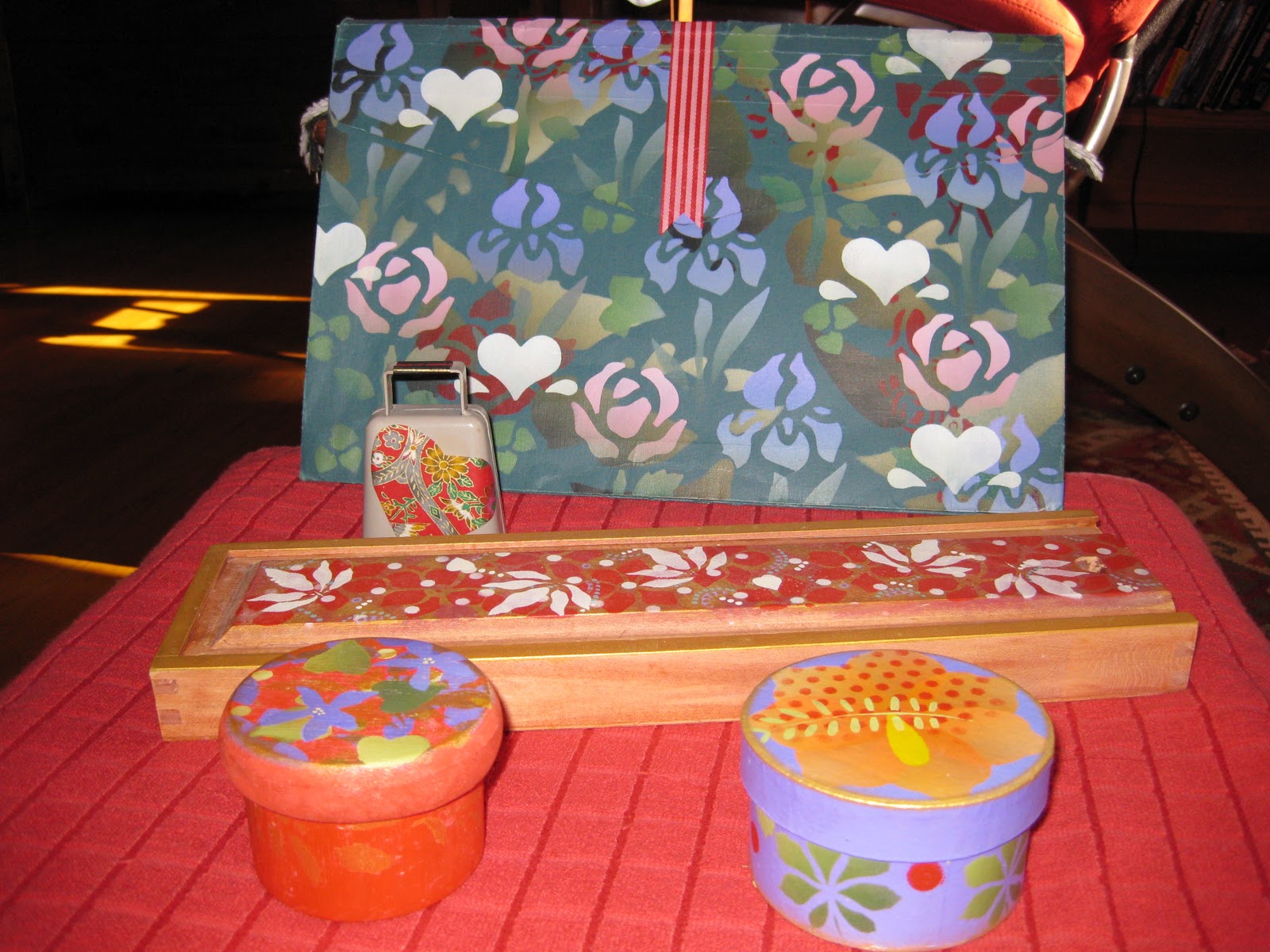
11/8/2010: Two days from my 67th birthday, and I miss Robert terribly. He always made such a fuss over me on my birthday, cooking me a special meal (vegan mushroom stroganoff and vegan chocolate mousse, for example), writing loving messages in carefully chosen cards, and either buying or painting something special for me.

 He painted a wooden cigar box to create a beautiful jewelry box to hold the earrings he delighted in gifting me. He decorated little boxes for me. He was moved by a story I wrote and painted a folder to hold it. He even decorated a cane when I was injured and couldn’t walk unassisted.

Prayers for Bobby today: Gay kids committing suicide
Gay teens are killing themselves — two 13-year-olds due to bullying (see this terrific blog post by Sue Katz), and a college student whose tryst was videoed and put online. It sickens me that young people just discovering their sexuality feel so vulnerable that it’s easier to die than to live. Those of us who have lived long enough to know ourselves, accept ourselves (including our sexuality — whatever its stripes or colors), and find or create a community that lets us live fully and honestly have a responsibility to pass this along to young people.
That’s how Leroy Aarons felt at age 61, and that’s why I’m repeating the following post from January 2009. I don’t know if you can find the Lifetime movie now, but the book is as valuable now as the day it was written. Please read it, then pass it along to someone who needs it. A life may depend on it.
Here’s what I wrote in January 2009:
 At age 61, prizewinning journalist Leroy Aarons discovered the true story of Bobby Griffith, a story so gripping that he devoted himself to retelling this story in novel form.
His book, Prayers for Bobby, has inspired a movie premiering on Lifetime TV, Saturday, January 24, 2009. It is the riveting true story of teenager Bobby Griffith, who back-flipped off a freeway overpass into the path of a tractor trailer at age 20 because he could not accept his homosexuality. Prayers for Bobby chronicles Bobby’s angst at growing up gay in a fundamentalist Christian family and an anti-homosexual social and school environment. Aarons gently and lovingly pieces together Bobby’s life, fears, hopes and, finally, hopelessness, with the help of the five year diary he left, his legacy.
Prayers for Bobby (subtitle: A Mother’s Coming to Terms with the Suicide of Her Gay Son) is also the story of Mary Griffith, Bobby’s mother, played by Sigourney Weaver in the Lifetime movie. A staunch, one-tracked fundamentalist, Mary was convinced that if she and Bobby just prayed enough, and if Bobby tried hard enough, God would cure him of his homosexuality. She prayed, she nagged Bobby relentlessly, she shamed him, she put Bible quotes on the mirror for him to see when he wakened. Too late, Mary finally realized with a thunderbolt of insight that the reason God had refused to cure Bobby was that there was nothing wrong with him.
What does this have to do with our age group? Plenty. Think about how we had to discover our own sexual and sensual natures despite the mores of our restrictive society in an era that condemned what seemed our most natural feelings and desires. Imagine being trapped in a world that didn’t understand you at a time you couldn’t even understand yourself. And reach out.
If you think you don’t know any closeted gay teenagers, it’s only because they are closeted. Maybe your “Bobby” is your grandson, or your granddaughter’s best friend, or the neighbor kid, or the quiet boy at church. We’ve learned a lot about life and about sexuality in the decades we’ve been living on this earth, and part of it is to accept ourselves and open ourselves to younger folks who might need a role model, a listening ear, and a warm “so good to see you today.”
Please see the movie, and read the book, which goes into much more detail and will haunt you in a beautiful way.
I am proud that I knew Leroy Aarons until his death four years ago, called him my friend Roy, and still enjoy a close friendship with Joshua Boneh, his surviving spouse. Please check out the website that Joshua and Roy’s friends have constructed in Roy’s memory and to celebrate the movie that he always hoped would be made about his book.
 (photo of Leroy Aarons and Joshua Boneh)