
Posts by Joan Price
Beyond Sags and Bags: MSN.com
Thanks to Jeremy Egner for his enlightening article, “The New Definition of ‘Sexy'” on the men’s lifestyle channel at MSN.com.
Egner cites a recent poll of more than 10,600 American adults that found that “sexy is more an attitude than it is a perfect physique.” More than 76 percent said a woman can be sexy if she was a size 14 or larger (well, sure!) and that “women (84 percent) are much more likely than men (63 percent) to say sexiness derives from an intangible quality … rather than looks.
Egner interviewed me about how non-physical qualities become even more sexy as we age. On page 2, he writes,
But as we get older and gain status, emotional security and hard-won wisdom, we’re looking less for hotties and babymakers than for compatible mates that will help create durable and rewarding relationships, says Joan Price, author, blogger and self-described “advocate of ageless sexuality.”
Such considerations feed our personal ideas about what is sexy. Other factors include our awareness of our own changing bodies.
“We have wrinkles, sags and bags. If having perfect faces and unlined bodies was a prerequisite for sexiness, we’d be out of the story already,” says Joan Price, 63, who wrote about evolving sexuality in her book, Better Than I Ever Expected: Straight Talk About Sex After Sixty. “We yearn for the same touch and intimacy but we have to first internalize the changed idea of what sexy is. We have to see ourselves as sexy.”
Price recalls asking her 70-year-old husband Robert, whom she married last May, to explain exactly how he could consider her to be as beautiful as he claimed when she could plainly see all her lines and physical imperfections whenever she looked into a mirror. (So don’t expect those sorts of questions to go away anytime soon, guys.)
“He told me, ‘If I am to know myself and accept my own aging process, how could I want anything less from you?'” Price says. “I tell that story sometimes when I’m asked to speak somewhere and women always ask, ‘Does Robert have a brother?'”
“When two people who really accept themselves come together, that’s where good sex happens,” she adds. “The most powerful sex organ is the brain.”
With this article, though, is a slide slow of the so-called “Sexiest Women Over 35,” which I found very disappointing. Why? The oldest “woman over 35” is Elle Macpherson, who is just 44 (a teenybopper in our world). Why isn’t Sophia Loren (73) on that list? Julie Christie (66)? Lena Horne (88)?  Or any of the other women listed on my post, How Old Are They Now?
Or does “over 35” have a nine year cut-off date?
This list is one more reminder of how much work is left to do in tearing down the stereotype of sexiness as synonymous with youth, and substituting real live role models of sexiness twice as old as the youngsters MSN.com chose as the “sexiest women over 35”!
Young Man Desires Older Women
Sean writes from Wisconsin,
I am 26 and have no problem getting dates with women my age. I’m a young professional and have confidence in my abilities with women my age. However, I am incredibly attracted to older women. I don’t want to say anything to friends because it feels abnormal, but I find such beauty in maturity. I work in a professional environment where I am around professional older women all the time. I can’t help but fantasize about them. I’m sure part of it is that my hormones are going crazy, but there really is something more to it. There is something about a woman who is well versed, educated, smart, and mature that drives me wild. Is this wrong? And if it’s not, do older women even take men my age seriously? When I’m talking to someone my age, it’s easy to read and give signs, because it’s commonplace for people in my age group to make a romantic connection – it’s on people’s minds. In conversation with an older woman, that assumption isn’t there. Is there anything you feel will work better for making a signal to an older woman? Are there any phrases (not pick-up lines) that would serve as cues? What should I look for?
Sean, I’m discovering that many young men are attracted to older women for exactly the reasons you say: “something about a women who is well versed, educated, smart, and mature.” Believe me, many women would jump at the chance to get to know you if they knew about you. Some suggestions for approaching an older woman who interests you:
- Converse, listen (very important!), and flirt as you would with a woman of any age. Yes, she’ll recognize the signs. She might be shy about letting you see her signs, in case she fears she’s misreading yours, so keep her talking.
- Don’t rush things along — she wants to know she interests you as a person, not just a potential bed partner.
- Look into her eyes a lot. Really listen and respond to what she’s saying.
- Lean towards her to give the body signal that you’re interested. Watch for these signs from her: eye contact; leaning towards you; arms relaxed (not crossed in front of chest); playing with hair, clothing, or jewelry.
- After a nice, long conversation, where you feel there’s a connection, you might ask her outright: “I wonder if there’s any reason I should not ask you out.”
- If she says, “I’m old enough to be your mother,” you can ask, “I really like the maturity and intelligence of older women. The question is, am I too young to interest you?”
- If you’re really brave, buy one of my books and carry it around. When she asks about the book, say something like, “I find older women very attractive, and I hope this book will help me understand them better — in all ways.”
I wrote about the experiences of Judy, 62, who loved men in their twenties in Older Women, Younger Men last September. Let’s keep talking about this, because I know it is a fantasy of many older women and younger men, and for some, it’s a passionate reality.
Don’t skip the sex part!
I was in the hospital following my cataract surgery, woozy from the sedative. Robert held my hand, attentive to the nurse who was reading us a checklist of postoperative instructions.
“Normal daily activity is fine, such as walking or light reading. Nothing strentous or jarring for one week, such as lifting heavy weights, bending all the way over, jogging…” she read in a crisp, clear voice.
Suddenly her voice lowered, becoming girlish and tentative. “Sex…” she paused, then whispered, “Do you want to know about sex?”
“Yes! Read the part about sex!” Robert and I almost yelled.
“You may resume sexual activities after one or two days,” she finished in a whisper, then raised her voice to the pre-sex level to read the rest of the instructions about bathing, protecting my operated eye, and treating discomfort.
“She almost skipped the sex part,” Robert said to me afterwards.
Why did the nurse feel the need to ask our permission and then whisper this one bit of information? I guess I should be used to this assumption that people of our age (63 and 70) are no longer interested in sex, and that approaching us with sexual information is embarrassing — but I wish this would change!
I keep saying that my mission is to change society one mind at a time. But darn, it’s taking a long time! Join me, please!
Dean asks, “Does Granny like oral sex?”
I just got an email from Dean, who describes himself as “a very active 70 year old” from Kansas. He asks this:
Joan: I have had sex with ladies 40 to 74 in the last ten years. However I am diabetic and take pills for high blood pressure, so due to those two items I am as you guessed, impotent to the Nth degree. I have had and given oral sex to several partners but I feel like they feel that this isn’t normal. My question, I guess, is, does granny really like this or is it that she feels, well, that’s all he can do? Can you come up with a ball park figure in percentages of the lassies that do and don’t get excited about oral sex? I have known ladies that were extremely sexual but would have nothing to do with oral. Is this very much the way granny thinks? Joan, I love the ladies and they like me, but what’s a relationship without a little pandering?
Dean, I imagine our readers will have plenty to say, but let me start out by saying that calling a woman with whom you want to have sex “Granny” just isn’t sexy! I don’t know how you interact with these women, or what you call them during pillow talk, but your wording here makes me wonder!
As far as whether older women like oral sex, there’s no percentage I can give you. I can tell you that the better the man is at giving oral sex — the more he tunes in to the sounds and movements that show him what she likes — the better she’ll enjoy it. That means not developing a one-technique-fits-all approach, but gathering many skills and the most important skill: being attentive to her cues and responding to them.
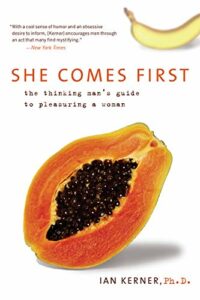
I’d like to recommend a book to you, Dean, and to every man who wants to understand better what a woman enjoys during oral sex: She Comes First: The Thinking Man’s Guide to Pleasuring a Woman by Ian Kerner. This book is clever, practical, and full of tips and techniques guaranteed to help any man become a better lover!