
Posts Tagged ‘books’
Healing Painful Sex: Interview with Deborah Coady, MD

I was happy to receive a review copy of Healing Painful Sex: A Woman’s Guide to Confronting, Diagnosing, and Treating Sexual Pain by Deborah Coady, MD and Nancy Fish, MSW, MPH. This book is entirely devoted to sexual pain in women: the myriad possible causes, how to figure out which one or combination is yours, and what to do about it.
The authors are a power team: Deborah Coady is a gynecologist and a pelvic/vulvar pain specialist. Nancy Fish is a therapist with degrees in social work and public health, and she personally experienced chronic pelvic pain until Dr. Coady helped her resolve it. I asked Dr. Coady if she would answer some questions that women our age often ask me:
Q. Many older women are reluctant to ask their gynecologists about sexual pain because a) they’re embarrassed, b) they think this is part of aging, and c) they fear their doctors will be dismissive. What would you say to these women?
A: These feelings and fears are completely understandable. Unfortunately, the medical profession has until now given too little attention to the sexual concerns of women as we get older. Women often are dismissed or rushed when they bring up their problems. And this is not the fault of the patients: A recent survey of gynecologists by Stacey Lindau, MD of the University of Chicago hints to their discomfort, as well as their lack of experience and formal training in this area of medicine. While 60% responded that they did ask about sexual problems at the first visit, only 14% asked about pleasure with sexual activity. It is often up to women themselves to be pro-active, ask the hard questions, and remember that they are entitled to medical therapy for this medical problem, or referral to an MD who can help.
Q. My readers sometimes report that after a long time without sex (due to lack of a partner or disinterest from a partner), they try to have sex again — and they can’t: It’s too painful. What should a woman do about this?
A: On average, about 5-6 years after their last menses, most women develop thinning of their vulvar and vaginal tissues, often causing pain with sexual touching or intercourse, or with urination after sexual activity, or itching, burning and even surface bleeding after sex. This can occur even in women taking systemic estrogen therapy. As estrogen levels decline both the surface skin and underlying connective tissues thin, shrink, and lose elasticity. Most pain is actually located at the vaginal opening itself, rather than deep inside the vagina as previously thought. The good news is that since these tissues are exquisitely hormonally sensitive, even small doses of estrogen, with or without testosterone or DHEA, applied to the vaginal opening (the vestibule), can reverse these changes within 2-4 weeks, and then even lower doses can be used to maintain the improvement. Some women with severe loss of elasticity will also be helped by a course of pelvic floor manual physical therapy, to help
normalize the connective tissue, and relieve the reflexive muscle spasms that some women develop due to their pain.
Q. I like your questionnaire (107-111) because women often don’t know how to pin down just where and what the pain is that they’re experiencing. I recommend that women scan or photocopy that questionnaire to show their medical professionals. Would it be a good idea to
carry a copy of Healing Painful Sex to the appointment, too, in case the doc hasn’t heard of your book?
A: One of our missions in writing the book is that women would have it as a resource to get their gynecologists informed and up to speed on treating sexual pain. Many patients have done just this, and their MDs have actually been grateful for the introduction to the book.
Q. If a gynecologist says, “You just need lubricant” or – worse! – “Well, at your age, you can expect that,” what should an older woman say to get diagnosis and treatment? I tell women to say, “If you don’t know how to help me, please refer me to someone who does,” but that might
seem more confrontational than you would recommend! What would you advise her to say?
A: I would advise her to say exactly that. We have to advocate for ourselves and we deserve up-to-date treatment for sexual pain. A healthy
sexual life is a basic human right, even defined as so by the World Health Organization!
Q. How can a post-menopausal woman weigh the benefits of HRT vs. the health risks if she’s experiencing vaginal thinning and tearing?
A: There is absolutely no evidence that the small amount of estradiol or estriol available for use at the vaginal opening is absorbed to any degree that would induce breast cancer. The doses are tiny compared to HRT doses that are meant to be systemic, that is, to go to all parts of the body. To help hot flashes the doses need to reach the brain in quantities much much higher than the topical estrogen will ever give. And with the evidence now showing that estrogen alone does not increase the risk of breast cancer anyway, women can be assured that topical therapy, especially if mostly applied to the vaginal opening, is safe. It is also now known that the thicker and more estrogenized the vulvar and vaginal tissues are, the less absorption into the body. So a stable constant regimen is better than going on and off the topicals, with the tissues thinning again in between.
Q. How do we educate our medical professionals to stop being dismissive and take our sexuality seriously, whether we’re 60, 70, or 80?
A: This is a work in progress, but educational outreach through professional societies like NAMS, the International Pelvic Pain Society (IPPS), and the International Society for the Study Of Vulvovaginal Disorders (ISSVD), as well as patient advocacy organizations, especially the National Vulvodynia Association (NVA) is helping. The websites of these societies all list health professionals by area to help patients find a knowledgeable MD. We also need to devote more time to formal education on sexuality and pain in medical schools and residency programs.
As always, I welcome your comments. If you’re experiencing pain with sex, I hope you’ll read both Naked at Our Age and Healing Painful Sex. Then please carry both books with you to show your doctor!
Fiction for Sex-Positive Seniors
It’s often frustrating to me that most contemporary fiction doesn’t reveal truths about my world as an older person. I’m always looking for books by writers of our generation about strong, senior characters. Given my own endless fascination with sex and relationships, I want the characters I read about to be sex-positive and in interesting relationships — or have interesting attitudes and activities if they’re not in relationships. I’ve compiled a few novels and short story anthologies that I’ve enjoyed lately whose authors and characters are men and women of our age and don’t shy away from sexuality. These recommended books portray characters whose sex lives are rich and varied–in reality for some, in their memories or imaginations for others.
Widow: Stories by Michelle Latiolais. I happened upon this collection of short stories accidentally — the title caught my eye because as a widow myself, I’m always grasping for understanding of how one goes on to live and love after the profound loss of a spouse. About a third of these stories are told from the point of view of widows; the others are narrated by women who experience loss in different ways. I had to ration myself to one story a day, because I needed time to think about — and sometimes recover from — what I had read. This passage, for example, made me cry, but I love it.
“For all her culture’s attention to the physical, it seemingly has little to salve the creatural anguish of losing someone else’s body, their touch, their heat, their oceanic heart. ‘Are you dating yet?” In other words, get another body … she doesn’t want another body, she wants the body she loved… One wants what one has loved, not the idea of love.”
An Available Man by Hilma Wolitzer. Edward Schuyler is a 62-year-old science teacher who is mourning the death of his wife. “Their sex life was more vibrant than anyone, including themselves, would have imagined,” we’re told early on. Grief is treated realistically: although Edward’s friends and family encourage him to start dating again, he worries that closing the door on grief might mean closing the door on his precious memories. (How real that felt to me!) He does start dating, and his fumbling attempts are endearing because we understand what he’s feeling. “I’m heartbroken… and I’m horny. There was an icebreaker for you.” If the mix of grief and dating intrigues you, you’ll be glad you read this novel.
Smut: Stories by Alan Bennett. If the title gets your attention, that’s intentional, but the book really isn’t “smutty” by our standards, though the characters’ actions would be considered smutty by their peers. This little book offers two long short stories, “The Greening of Mrs. Donaldson” and “The Shielding of Mrs. Forbes” by a British dramatist born in 1934. Mrs. Donaldson is a 55-year-old widow (she seems older to me) whose job is role-playing medical conditions for doctors in training in an array of entertaining scenarios. She takes in boarders, college students who can’t always pay the rent, and so she watches them having sex instead. The other story deals with a narcissistic, closeted gay man who marries a woman and has trysts with a man who blackmails him; his mother; and his father who — no, I don’t want to give away that part.
Breaking Out of Bedlam by Leslie Larson. Cora Sledge, an 82-year-old widow, has been forced to leave her home for an assisted-living facility because her kids have decided (and rightly so) that she’s a danger to herself. She decides to write a scandalous, tell-all journal about her life — past and present. Her story is sometimes tragic and often harsh, but because of her/Larson’s manner of telling it, it’s also hilarious. Add to the mix a romance in the nursing home (is he devoted? or trying to use and cheat her?) and a bit of a mystery– and did I mention that you’ll enjoy the sex scenes?
 In One Person by John Irving. I’ve saved this gem for last because it’s my favorite book of the year so far. The main character is a bisexual, 68-year-old man looking back at the influences — many of them sexual — that shaped his life. I’ll never forget Miss Frost, though it would be a spoiler to tell you why. This compelling, beautifully written novel will make you think about the people and events along your own life’s journey that helped you form your sexual identity and attitudes. It’s a long book (448 pages), but I can’t imagine you wanting to put it down. I listened to the Audible Audio edition, which is superb.
50 Shades of Grey Hair
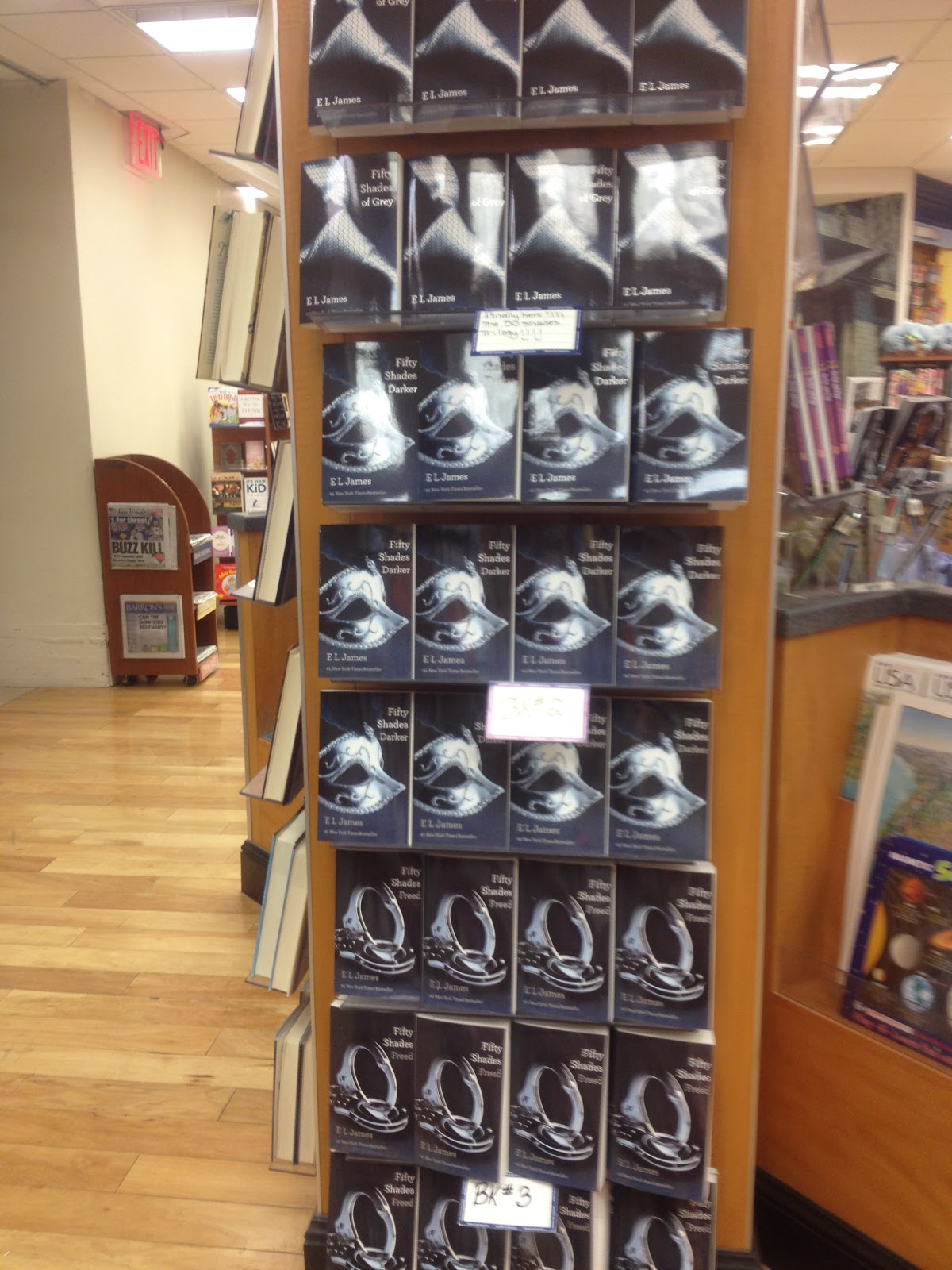
If you’ve been awake on this planet, you’ve heard of the success of Fifty Shades of Grey. It’s the Number 1 best seller on Amazon, where it sports 3,639 reader reviews at this moment.*
The big deal about this book is that it’s erotica, BDSM erotica at that, and it’s being read by a mainstream female audience — everyone from teens through their moms and, yes, grandmoms of our age, too. Many start reading it because everyone else seems to reading it, and we like to be shocked.
I didn’t read the whole book, but I did read quite a bit during a very long airport wait at JFK, where I found a mile-high display of all three Shades of Grey books. How did the author, E L James, come out with three books so fast? From the quality of the writing, I’d say she wrote them quickly, didn’t rewrite, and didn’t have an editor. Otherwise, how could she repeat herself all these ways, as an Amazon reviewer points out:
Ana bites her lip 35 times, Christian’s lips “quirk up” 16 times, Christian “cocks his head to one side” 17 times, characters “purse” their lips 15 times, and characters raise their eyebrows a whopping 50 times. Add to that 80 references to Ana’s anthropomorphic “subconscious” (which also rolls its eyes and purses its lips, by the way), 58 references to Ana’s “inner goddess,” and 92 repetitions of Ana saying some form of “oh crap” (which, depending on the severity of the circumstances, can be intensified to “holy crap,” “double crap,” or the ultimate “triple crap”)…Characters “murmur” 199 times and “whisper” 195 times (doesn’t anyone just talk?), “clamber” on/in/out of things 21 times, and “smirk” 34 times. Finally, in a remarkable bit of symmetry, our hero and heroine exchange 124 “grins” and 124 “frowns”… which, by the way, seems an awful lot of frowning for a woman who experiences “intense,” “body-shattering,” “delicious,” “violent,” “all-consuming,” “turbulent,” “agonizing” and “exhausting” orgasms on just about every page.
Readers recognize the bad writing — more than 1,000 reader reviews are only 1-star — but what the heck, it is sexy (of course “sexy” is in the eyes of the beholder). Anastasia gets lots of orgasms, and isn’t it a fantasy of women at any age to have an extraordinarily handsome, insanely rich lover who gives us endless orgasms — and, by the way, has inner turmoil that we’re convinced only we can fix by offering him our special brand of devotion?
Our age group is reading this book, too, and not just women. I enjoyed the reader review from “a male senior citizen, a semi-retired gynecologist,” whose “arthritis flared up just reading about Ana’s sexual gymnastics.” He had to take Viagra to stiffen his resolve to keep reading.
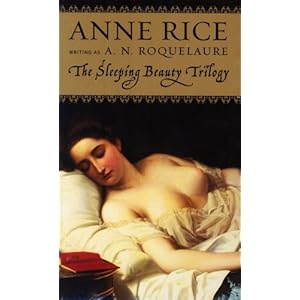
If you’re interested in BDSM erotica, there are plenty of well-written books you can read, with the sex you’re looking for plus skillful, non-repetetive writing and unpredictable characters and plots. For example, try the Sleeping Beauty Novels, a trilogy by Anne Rice writing as A.N. Roquelaure, or check out the many BDSM erotica anthologies from Cleis Press. If it isn’t specifically BDSM but simply well-written erotica you’re looking for, both Cleis and Seal Press do a great job. Starting with an anthology can introduce you to writers whom you particularly enjoy, and from there you can explore what else these writers have written.
What would Fifty Shades of Grey look like if it featured a woman our age, instead of a college student? We could title it Fifty Shades of Grey Hair, and our heroine would be a woman of, say, 68, who has left a long, boring marriage and goes to San Francisco or New York City to discover her hitherto hidden sexual kinks. She hooks up with a dom who is maybe 72 and in the best of health and vigor, who uses plenty of lube while he introduces her to his special brands of toys, fingers, tongue, and penis, to bring her to the ultimate heights every few pages. I say “every few pages” instead of “every page,” because we need longer foreplay these days.
Or maybe she doesn’t find a dom — maybe she’s the domme, exploring her personal power in ways she has only fantasized.
You see how much fun this could be? Fifty Shades of Grey Hair wouldn’t suffer in any way by being about senior sex. In fact, by featuring savvy, sexy seniors, we wouldn’t need any of the lip chewing and we could be more inventive with our reactions than “oh, crap.” What do you think?
(If you love the idea of senior erotica, I’m editing a senior sex erotica anthology right now with Seal Press. I’ll let you know when it’s published!) Update: Ageless Erotica is available for your reading pleasure!
*I can’t help comparing: my Naked at Our Age has 20 Amazon reviews–all raves except for one that found it offensive because too much of it is “about how to give yourself an orgasm.” Here I thought that would be a useful part of a senior sex self-help sex guide….
The Ultimate Guide to Kink: book review
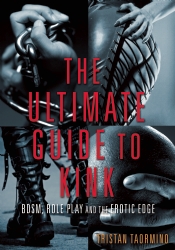 I was, at first, conflicted when Cleis Press invited me to review The Ultimate Guide to Kink: BDSM, Role Play and the Erotic Edge, ed. Tristan Taormino. I’m so unkinky personally. I like gentle sex, and although I had a “try anything twice” motto a few decades ago, by now, I feel pretty secure in knowing what works for me, and it’s decidedly, deliciously, vanilla.
I’ll admit it, I’ve never understood what could be pleasurable about pain. I’ve been in two devastating automobile accidents with residual and lifelong pain, I shattered my shoulder in ten places two years ago, I have arthritis in my neck — I know pain. I couldn’t imagine bringing pain intentionally into my sex life. Imagine my surprise reading this in Tristan Taormino’s introduction:
| Tristan Taormino |
When people experience pain, adrenaline, endorphins, and natural painkillers flood their nervous system. People get off on this chemical rush, which many describe as feeling energized, high, or transcendent… In the context of a sexually charged scene, some people, when they are aroused (and their pain tolerance is much higher), process a face slap in a different way: it feels good.
Oh! Now I get it. (Are true kinksters laughing at my innocence?)
- Patrick Califia, who writes “Butthole Bliss: The Ins and Outs of Anal Fisting” (“one of the most extreme sexual acts that one person can allow another to do to his or her body”) and “Enhancing Masochism: How to Expand Limits and Increase Desire.” He defines masochism as “the desire and the ability to become aroused and perhaps even climax while experiencing sensations that other people avoid.”
- Hardy Haberman, who writes “A Little Cock and Ball Play,” including household items you can use as sensation implements: toothbrush, paintbrush, nylon scouring pad, mushroom brush….
- Jack Rinella, who writes “The Dark Side.” As the Dark Lord, he advertised for men who desired to be “subjugated, degraded, dominated, humiliated, and violated” — about 120 men responded.
- Lolita Wolf, who writes “Making an Impact: Spanking, Caning, and Flogging,” including choosing an implement, techniques, and why the bottom and the top enjoy it.
- Barbara Carrellas, who writes “Kinky Twisted Tantra,” including “The Tao of Pain.”
Patrick Califia challenges those who brand BDSM players as “mentally ill”:
The assumption that variant sexualities are mental illnesses has more to do with conservative religious values than it does with objective observation. If a mental state or human behavior is unhealthy, we ought to be able to demonstrate that it makes that person unhappy, interferes with their ability to give and receive love, prevents them from setting goals that give them a sense of fulfillment, and injures their health.