
Posts by Joan Price
Seniors: How (and what) is your sex life?
It occurs to me that after 11 years of talking out loud (shouting, insisting, cajoling, writing) about senior sex, the questions that interviewers ask me have become quite intelligent and open-minded.
When I first started this work, interviewers would ask elementary questions (e.g. “Is it true that seniors are having sex?”) and would often place a value judgement on what they heard (e.g. “Yeah, but eeuuww, the idea of my parents/grandparents having sex…!”)
But now, however young the interviewer is, there’s an open attitude, a nonjudgmental striving to understand. It’s not such an odd idea anymore that we aren’t retiring our genitals at some arbitrary age. This is progress! Or am I just lucky enough to be interviewed by smarter, more sex-positive interviewers?
One topic that interviewers find endlessly fascinating is that we’re not settling into old age passively or predictably. Many of us decide that it’s time to go after what we want, whether or not it’s what we used to want or ever thought we’d want.
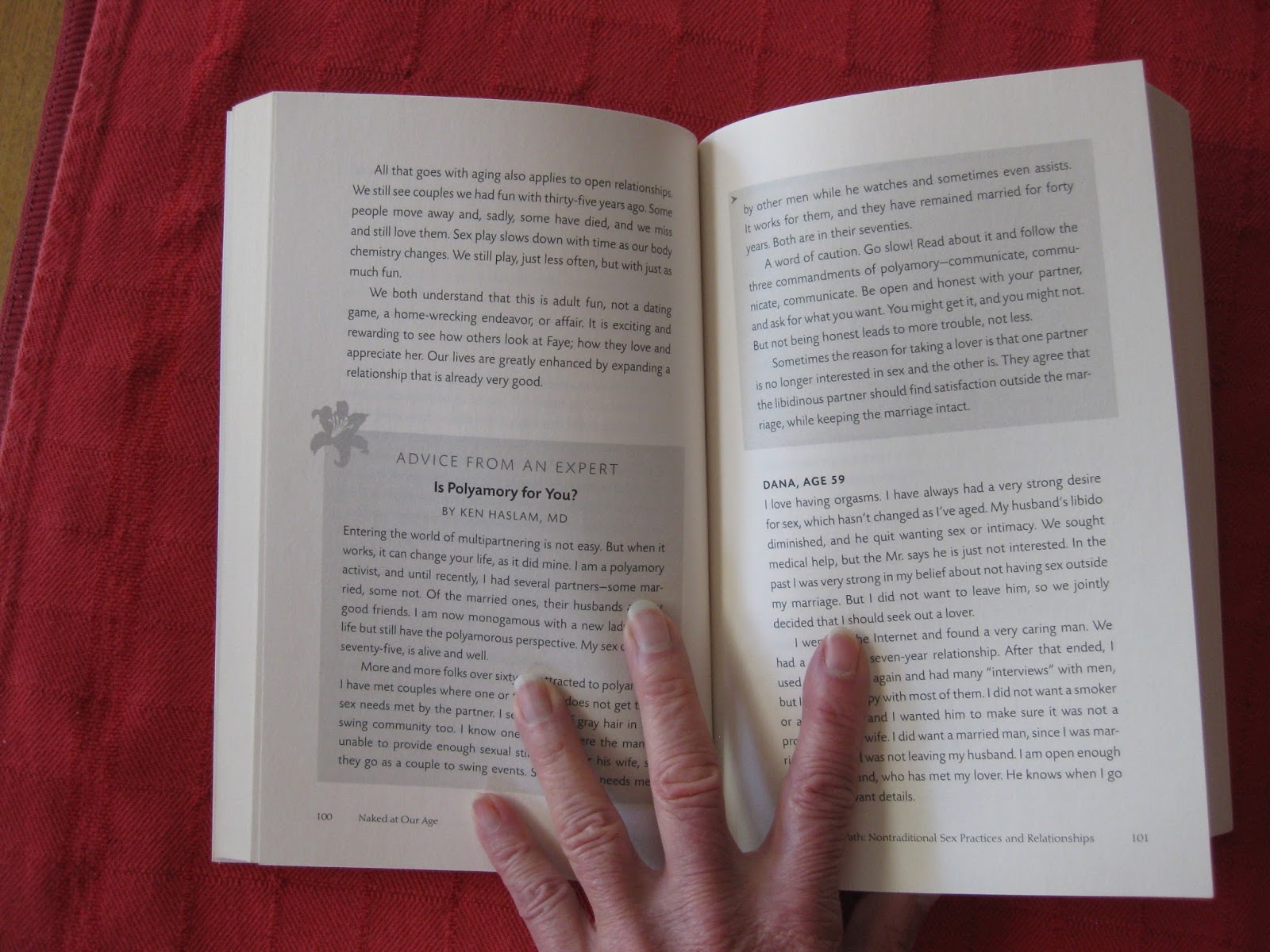 I wrote about this in the “Stretching Boundaries” chapter of The Ultimate Guide to Sex after 50, and many of you contributed your experiences in the “Off the Beaten Path: Nontraditional Sex Practices and Relationships” in Naked at Our Age. I’m often asked, “What percentage of seniors are into kink?” or “Are many seniors polyamorous?” or “Are most seniors happier with their sex lives than they were when they were young?” I sometimes answer, “I don’t collect statistics — I collect stories.”
Yes, some studies have been done, but more often than not, research and surveys either overlook our generation entirely or only study straight relationships and define sex as heterosexual intercourse, which is just one form of sexual expression. I don’t think that our generation is being asked the right questions about what we do, what we want, and how we feel about it.
So I’m opening this up to you: If you’re over 50 (lots older is fine!) and you find that your ideas have changed about what you want your sex life to be, please feel free to comment with your views and especially how those views have changed in recent years. Please give yourself a first name (doesn’t have to be real) instead of “Anonymous” and include your real age. (If you have any trouble posting a comment, email me with the subject line “blog comment: how and what” and include what you want to say, what name you want to use, and your age, and I’ll post it for you.)
I started this discussion on my Naked at Our Age Facebook page, which I hope you’ll read, “like,” and share. Thanks!
Learn more about my most recent book, The Ultimate Guide to Sex after 50. Order here for an autographed copy, purchase from your local independent bookstore, or order from Amazon.

Sybian Update: New Silicone Attachments!
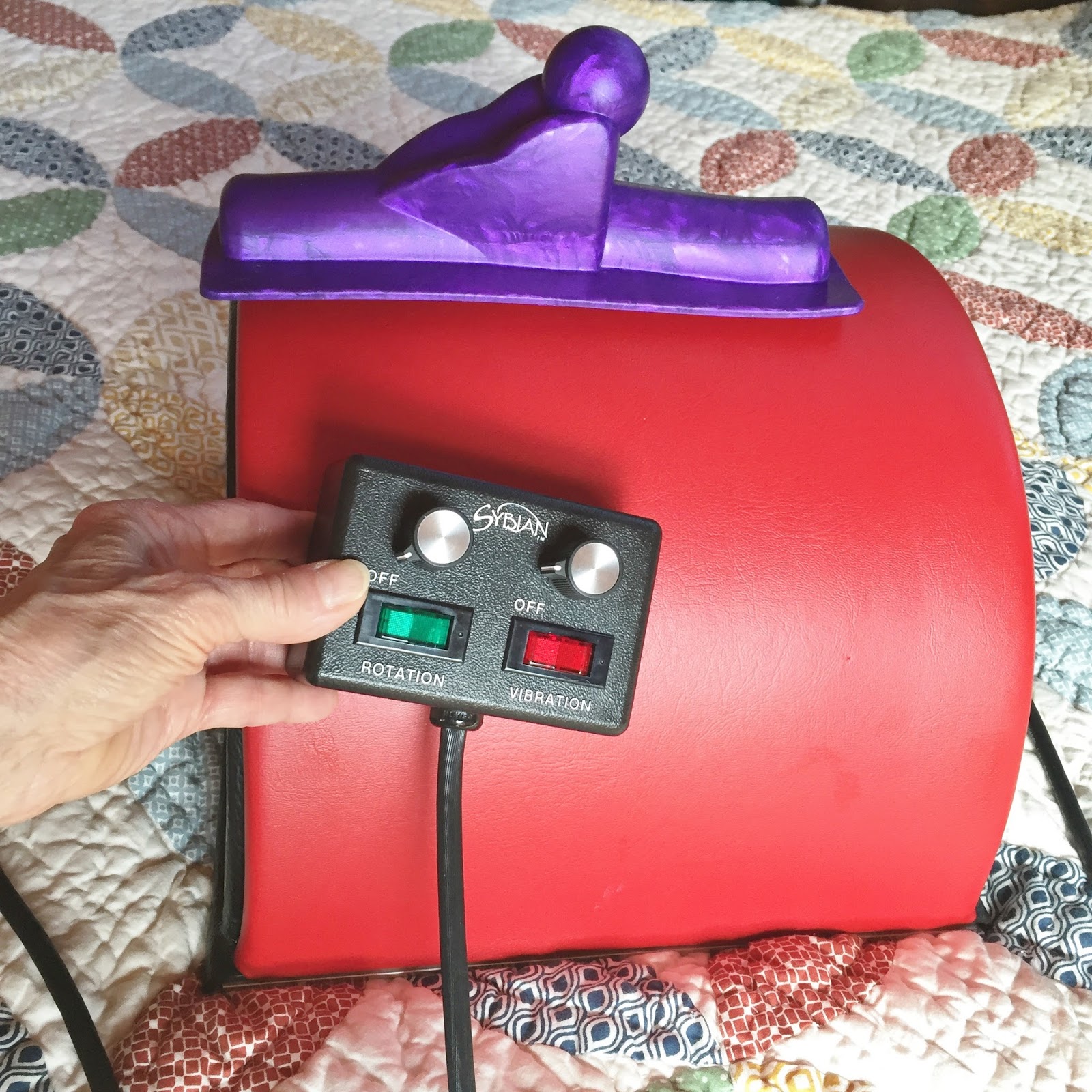 Sybian goes silicone! The wonderful folks at Sybian have been tirelessly working on how they can increase our pleasure and our orgasms, and use body-safe, easy-to-clean silicone. They’ve just created two beautiful silicone attachments that are rocking my world.If you’re saying, “What’s a Sybian?” please read my original review first. Then return here to learn what’s new.
 If your preference is vibration to your clitoris and vulva without penetration, the unique design of the Orb is my dream vibrator. It consists of an orb (hence the name) at the top of a ramp-like structure, and all of it vibrates powerfully.
This is perfect for those of us who like stimulation to a large area — not just the clitoral glans, but the whole vulva. It can be used in several ways, depending on how you position yourself and it:
1. You can press the ramp part against your labia with the orb at your clitoris.
2. Turning the Sybian around, you can press the orb against your vaginal opening and the ramp slides over your labia and clitoris. You may find it challenging to get into position if you’re straddling the Sybian for this position — see the alternative “Recline and Tilt” described below.
3. If you just want the orb against your clitoris, you can turn it around so that the ramp doesn’t contact anything — you just feel the orb part.
Experiment — there’s no way to use it “wrong.”
 If you like penetration and you prefer a slender width, the G-Wave stimulates your G-spot with a smooth bulb that’s only 1.27″ in diameter, atop a stem that’s even more slender: 1.1″ in diameter. Sybian really listened to me when I told them that many of us in our later years prefer — even require — a slender toy for penetration.
Because the penetrating part rotates rather than thrusts, it can feel much fuller than the measurements indicate, depending on how high you dial the rotation. Slick the G-Wave with lubricant, and it inserts smoothly and gently or strongly (your choice) rotates in your vagina, stimulating your G-spot. It doesn’t feel like a penis — it feels more like a lover inserting a couple of well-placed fingers and moving them around. Delicious.
The “wave” part (see the wavy lines?) rests against your labia and clitoris and vibrates you to paradise. I like the width of the wave section — it vibrates against your whole vulva. The vibration control is separate from the rotation, so you can dial it to vibrate to any intensity from light to rumbly strong to I-can’t-believe-I’m-experiencing-this — you’ll decide what your limit is.
Suggestion: Start with a low vibration and no rotation. As you become aroused, dial up the vibration a little at a time, and add the rotation if you like it.
 If you look up other reviews of the Sybian, especially the videos on YouTube, you’ll think that the only way to use this phenomenal sex machine is by mounting it. You can do that — either on your knees (yeah, like we can get on these old knees at our age?) or with the Sybian on a platform and your feet on the floor. However, there’s a much easier and more comfortable way to use it. I’ve nicknamed it “Recline and Tilt.”
As I suggested in my earlier review of the Sybian:
If straddling is uncomfortable for your hips, or if you can’t relax that way, you can lie down on your bed with the Sybian between your legs on its power-cord end. Then tilt it forward so that the attachment contacts your genitals without putting weight on you. It’s fine to use it this way — it won’t harm the Sybian or you.
 Once I discovered how well that position works, I never went back to mounting my Sybian. Both of these new attachments are particularly fabulous if you’re reclining, relaxed, and tilting the Sybian onto you or into you.
If you already own a Sybian, these attachments will add tremendously to your pleasure. If you don’t already own a Sybian, Bunny Lampert, daughter of the inventor, is offering my readers a $75 discount with the code “JOAN75“!

Order the Orb, the G-Wave, or both attachments here. Learn more about the Sybian here.
 Bonus: These silicone attachments also come with pretty, satin storage bags.
22-year-old man: “How to approach older women?”

Jan. 23, 2016 update: I’m getting so many questions on this subject. I get emails from younger men — mostly age 18 to 30ish — who are attracted to older women (usually 60+). So I’m resurrecting this earlier post and inviting comments from both young men about what attracts them to older women and from older women about how a younger man can find them and make contact. Are any of the online dating sites especially good to help younger/older connect?
Note: I am NOT matchmaking here, though many young men have begged me to post their email addresses or phone numbers. No, I won’t do that. And guys, please don’t ask me personally to hook up with you! That kind of request — yes, I do get them — feels creepy, and I won’t even answer to tell you to stop it. Just stop it. And no, I don’t want to know how big or hard your penis is or how long it can perform — and I really don’t want to see a photo of it. Just. Stop. It.
So, that said — most of the people who ask for help are sincere, respectful, and sensitive to their partner’s desires and pleasure. Realize that our age and experience has not turned us into an alien species — treat us like valued human beings, interesting for more than sex.
Leopardy is a 22-year-old male in Australia who likes older women. He emailed this story to me:
I’ve had 2 women in my life (sexually only). Great fun, I must admit, but it tears you apart when the bad has to come up. I like older women for their maturity and for their gorgeous features, such as lips, hips, legs, and fragrance, mmmmmmm. I admit I find it rather hard to find the perfect older woman as they all tend to lead me on then shoot me off which hurts like hell.
I met a woman online back in 2004. After 3 months chatting I gave her my details and she came up here. We had sex, and then she really got abusive and threatened me with police threats etc. She told her so-called friends about me and said what a pathetic useless peice of shit I was.
I’d like to know how to approach older women. I just want a woman that can understand me, one that takes me for who I am and NOT degrade me in any way.
Thank you for been so supportive and having a wonderful site. I can’t even recall how I got hold of your site, but I was amazed and immediately added it to my favourites.
Leopardy, I encourage you to get to know the older women who attract you before you jump into bed with them. Those who are looking for quick fun probably won’t value you the way you want. It’s fine to seek a match online, but if you seem to connect, please take some time dating and becoming friends so that you know who she is and she knows you.
That might mean you don’t get the instant pleasure and excitement of sex with a stranger who seems to fit your fantasy, but if what you’re looking for is a respectful relationship, that takes time to unfold and nurture.
That doesn’t answer your question about how to approach older women. I’ll repeat the suggestions I gave Sean:
- Converse, listen (very important!), and flirt as you would with a woman of any age. Yes, she’ll recognize the signs. She might be shy about letting you see her signs, in case she fears she’s misreading yours, so keep her talking.
- Don’t rush things along — she wants to know that she interests you as a person, not just a potential bed partner.
- Look into her eyes a lot. Really listen and respond to what she’s saying.
- Lean towards her to give the body signal that you’re interested. Watch for these signs from her: eye contact; leaning towards you; arms relaxed (not crossed in front of chest); playing with hair, clothing, or jewelry.
- After a nice, long conversation, where you feel there’s a connection, you might ask her outright: “I wonder if there’s any reason I should not ask you out.”
- If she says, “I’m old enough to be your mother,” you can ask, “I really like the maturity and intelligence of older women. The question is, am I too young to interest you?”
 If you’re really brave, carry a copy of one of my books. When she asks about the book, say something like, “I find older women very attractive, and I hope this book will help me understand them better — in all ways.”
I’d love to hear from readers about this topic. I know many readers come to my blog seeking information about older women/younger men relationships, so please contribute yours.

— Joan
How to Tell Your Partner What You Want: guest post by Esther Perel
How can I tell my man what I want? If I get even slightly turned on, he takes it as a sign that he can simply proceed straight to the gate for take-off. He’ll stimulate me for 30 seconds and get inside me. And in my mind I’m thinking: ‘I wish he would move a little gently, have his hands all over my body. Then I might ask him to kiss me in a certain spot, so I’ll give him a sort of hint of what would feel good.’ Sometimes he gets it, and he responds. But other times – he doesn’t seem to hear me.
 |
| Esther Perel |
Amy, age 43, sent this question to therapist and author Esther Perel. Although Amy is a little younger than our age group, both the question and Perel’s answer are so relevant to the readers of this blog that I asked Perel for permission to republish her blog post here. She graciously agreed. Here’s what she told Amy:
If everyone communicates their needs openly, everyone gains.
Women are constantly told that they need to tell their partner what feels good to them sexually, to be proactive with their desire, to be more assertive and bold. For many people, this is easier said than done. It can feel safer to remain passive and take from our sexual encounters what we can get. Women often tell me that they really like to linger in the pleasures of the preliminaries, that they like them as much, if not more, than the act itself, yet they tend to accommodate their partner and abdicate their wants. They tend to go along with a more stereotypically male definition of sex, where foreplay is the mere introduction to the ‘real’ thing.
However, it is precisely the anticipation, the seduction, the playful touch, the kissing, stroking, and gazing into each other’s eyes – all the stuff that fuels desire and excitement – that make them feel desired. It is those exquisite aspects of foreplay that, for women, often make up the real thing.
Many of the women I work with in my practice worry that they take too long to climax, that their partner will be bored. Once he reaches orgasm, they give up theirs as if his rhythm defines hers. They fake their orgasms, they pretend. They tell me: ‘His ego is too fragile’. ‘I don’t think he can hear me’. ‘I don’t want to hurt him.’ Or: ‘I don’t want him to be angry and to reject me.’ Or even, sometimes, ‘I don’t know what I want, all I know is that I don’t want what I have.’ Men like to hear the guidance, but they can’t stand the criticism. It eats away at their sexual confidence. ‘No sooner do I touch her than she starts dictating to me what to do. I feel so tense following instructions. This tickles, this rubs. Here, she is too dry; there, she is too wet. Slower, faster, harder, softer, it doesn’t stop.’
Obviously, it’s tough on the partners too — these sorts of requests can come across as commands at a time when both people in the room are at their most vulnerable.
Talk about your preferences and desires before and after intimate moments, not only during them.
For women and for men, when we feel sexually frustrated we are likely to be irritable, less patient, more aggressive and tactless. Instead of saying ‘I would like more stroking’, we say: ‘Why do you always go straight for my breasts?’ or ‘You never kiss me’ or the crowning put-down: ‘I never had this problem with my previous girlfriend.’ As a rule, sexual communication around what we want and how we want it is better discussed outside the bedroom, not while we are engaging with each other. Expressing appreciation for having your partner in your life is critical to helping him or her feel confident to take in all your needs, without seeing your complaint as a diminishment of his masculinity or her femininity.
Utilize non-verbal communication.
I am a therapist, so I obviously value talking, but I also challenge the insistence of the verbal as the superior way to communicate. We speak with our bodies, with actions, with a gaze. The body, as a matter of fact, is our mother tongue; we express so much in the physical language long before we can utter one word. While I think that talking is important for couples, we are facing a situation where sharing is not a choice but a mandate. There is this perceived wisdom that if you don’t share or talk, you are not close. That is a false assumption and one that puts a lot of pressure on men in particular. There’s a lot to gain from showing your partner, non-verbally, what you like. Gently take his or her hand, guide it, move around so that you have got it where you like it.
Although this is a heterosexual example, I also see examples of a similar dynamic in same sex couples — where one partner capitulates to the other’s needs, or simply does not feel comfortable communicating what he or she wants to experience. Both men and women fall in the trap of believing that if you need to discuss methods, it means there is not a good sexual connection. How about rethinking that? Doesn’t it make more sense that if you feel you can communicate your wants openly, that’s the ‘real’ sign of a good sexual vibe?
Do you effectively communicate your physical and emotional needs to your partner(s)? If not, what’s holding you back? What tactics have been most successful to getting what you want? Leave your comments below and join the conversation.
 Esther Perel is recognized as one of the most insightful and provocative voices on personal and professional relationships and the complex science behind human interaction. Perel is a practicing psychotherapist, celebrated speaker, and the best-selling author of Mating in Captivity: Unlocking Erotic Intelligence, translated into 25 languages. The New York Times, in a cover story, named her the most important game changer on sexuality and relationships since Dr. Ruth.
Perel is a two-time TED speaker: Her critically acclaimed viral first TED talk reached nearly 5 million viewers in the first year and recently released second one, on the topic of infidelity, was viewed nearly 2 million times in the first month. Watch her here: